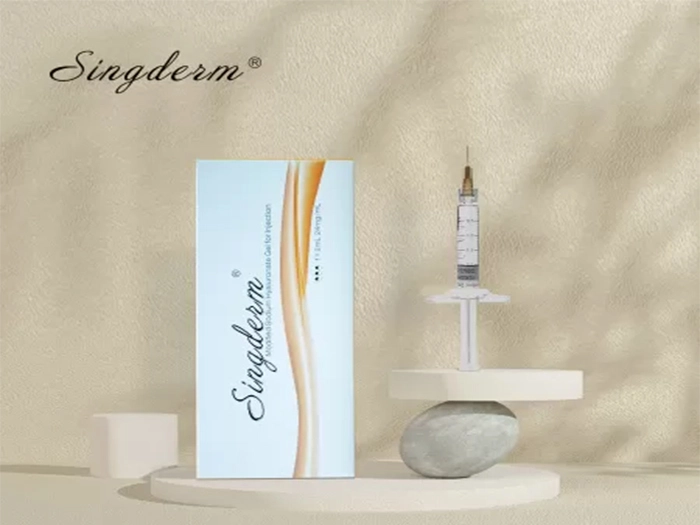

PLLA vs. HA Fillers: Key Differences in Long-Term Volume Restoration via Collagen Regeneration
For years, hyaluronic acid (HA) fillers have dominated the facial rejuvenation market. However, a fundamental shift is underway — moving from physical occupancy to biological regeneration. For clinic owners and distributors targeting the 30+ demographic, understanding the clinical and economic differences between HA and poly-L-lactic acid (PLLA) is no longer optional.
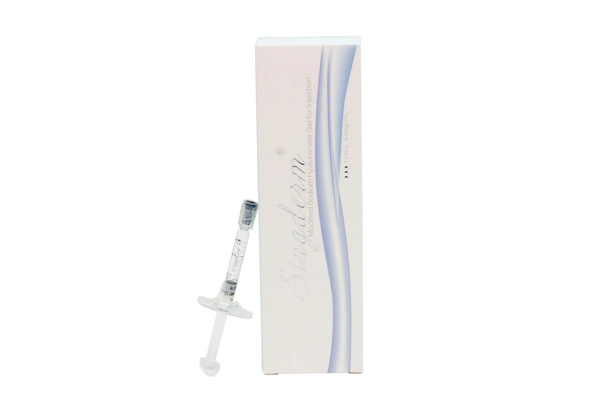
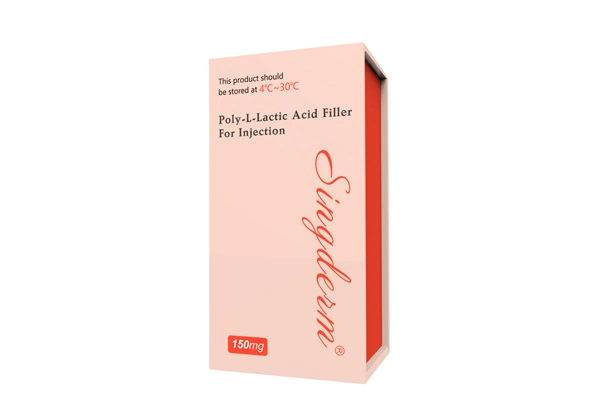
This article provides a data-driven comparison to help you position Collagen Stimulating Filler such as Singderm® PLLA within your portfolio.
1. Mechanism of Action: Filling vs. Regenerating
Hyaluronic Acid Fillers
HA fillers work through physical occupation. They absorb water to create volume, but do not stimulate new collagen. The body degrades HA via hyaluronidase, typically within 6–12 months, requiring repeat touch-ups.
PLLA (Poly-L-lactic acid) Fillers
PLLA is a biodegradable synthetic polymer derived from natural sources (corn, cassava). As noted in Singderm’s clinical data, it acts as a Collagen Stimulating Filler:
· Step 1 (Day 1): The PLLA suspension provides an immediate filling effect.
· Step 2 (Days 3–14): Water is absorbed, and initial volume subsides. Simultaneously, PLLA activates fibroblasts.
· Step 3 (Day 28 onwards): Fibroblasts produce Type III collagen (tissue repair) followed by Type I collagen (structural network rebuilding).
· Result: A gradual, natural correction of depressions, lifting, and firming.
2. Clinical Timeline & Collagen Regeneration Data
Time Point | HA Filler | Singderm® PLLA Filler |
Immediate | Full volume | Temporary (carrier fluid) |
2 weeks | Peak effect | Initial volume subsides |
1–3 months | Gradual degradation | Collagen begins deposition |
6 months | 50-70% remaining | 93.6% wrinkle improvement (nasolabial) |
12–24 months | Mostly gone | 18–24 months duration with active collagen |
Key clinical proof (Singderm multi-center, randomized, double-blind trial, n=275):
At 6 months post-last injection, the improvement rate for nasolabial fold wrinkle score was 93.60% in the test group (Singderm PLLA), compared to 90.15% in the control group (domestic similar PLLA product).
Additionally, over 24 months:
· Type I collagen regeneration rate: up to 110.41%
· Type III collagen regeneration rate: up to 20.89%
No HA filler can produce such biological remodeling.
3. Indications: Not Competitors, But Allies
Best for HA Fillers
· Dynamic wrinkles (crow’s feet, glabellar lines)
· Lip augmentation
· Tear troughs
· Areas requiring reversibility
Best for PLLA Fillers (Singderm®)
· Deep volume loss: temples, cheeks, submalar regions
· Sagging contours: jawline definition, nasolabial folds (fat pad descent type)
· Large-area biostimulation: patients wanting gradual, natural lifting over 2 years
Suggested Combination Protocol for Clinics
· Deep layer: Singderm PLLA to rebuild collagen scaffold
· Superficial layer: HA for fine detailing
→ Reduces total HA volume per patient → increases profit per session.
4. Singderm® PLLA: Technical Advantages Over Other PLLA Products
Based on Singderm’s internal comparison data (vs. European/American Brand S, Korean Brands, and Chinese Brands):
Parameter | Typical PLLA (Brand S/L) | Singderm® PLLA |
Particle shape | Irregular/flake-like | Smooth microspheres |
Particle size (D50) | 40–63 μm | 20–50 μm (optimal range) |
Reconstitution time | 2 hours – 24 hours | 1 minute |
Suspension stability | Sedimentation within 60 min | No obvious sedimentation within 60 min |
Raw material source | Not specified | German import, purity 99.9% |
Specifications | Single (150mg PLLA) | 4 options (60/90/120/150mg PLLA) |
Why smooth microspheres of 20–50 μm matter:
· <20 μm → may be phagocytosed or pass through capillary walls
· >50 μm → may cause inflammatory reactions/nodules
· Smooth spheres induce lower immune response than irregular particles
This makes Singderm a Collagen Stimulating Filler with both efficacy and safety.
5. Economic Value for Clinics & Distributors
For Clinics (per patient, 18-month horizon)
Item | HA-only protocol | PLLA (Singderm) protocol |
Initial sessions | 1 session, repeat every 6–9 months | 3 sessions (1 month apart) |
Patient visits | 2–3 times per cycle | 2-3 visits per 18–24 months |
For Distributors
· Differentiation: PLLA is a premium regenerative category, not commoditized like HA.
· Cross-selling: Offer Singderm’s 4 specifications (60–150mg) for precise dosing – from preventive anti-aging (ages 25–30) to deep correction (ages 30–50+).
· Support: Backed by granted patents in China and Germany, with US/UK applications pending.
6. Practical Considerations: Reconstitution & Injection
Singderm PLLA is a lyophilized powder requiring reconstitution:
1. Add 5mL sterile water for injection to 405mg vial (adjust for other specs).
2. Shake well, let stand 30 minutes to remove bubbles.
3. Use 22G needle to draw suspension, then switch to 26G needle for injection.
4. Inject into deep dermis at 30–40° angle, then advance at 10–20°.
5. Massage every 3–4 injection points for uniform distribution.
Critical for clinics:
Unlike product S which requires regular post-injection massage (due to flake-like particles), Singderm’s smooth microspheres allow better absorption with lower risk of nodules.
7. Target Patient Profiles (from Singderm positioning)
Type | Age | Need | PLLA fit |
Naturalist Seeker | 30–50 | Avoid “frozen face” | Gradual collagen regeneration |
Aesthetic Repair | Any | Correct previous HA/thread lift | Physiological volume increase |
Premium Anti-aging | 35–50 | High-net-worth, refuse frequent touch-ups | 18–24 months effect |
Young Prevention | 25–30 | Early intervention | Lower dose (60–90mg) |
Conclusion: Why Your Clinic or Distribution Should Include Singderm® PLLA
HA fillers remain excellent for superficial lines and reversible needs. But for long-term, physiological volume restoration that leverages the body’s own collagen, poly-L-lactic acid filler is the future.
Singderm® PLLA offers:
· Proven clinical efficacy (93.6% wrinkle improvement)
· Superior safety (smooth microspheres, German 99.9% purity)
· Operational convenience (1-minute reconstitution, 60-minute stability)
· Economic logic (higher patient LTV for clinics, differentiated SKUs for distributors)
Learn more about Singderm Injectable PLLA Filler specifications & clinical data
 Call us on:
  Email Us:
  No. 125(E), 10th Street, Hangzhou Qiantang Area, Zhejiang, China