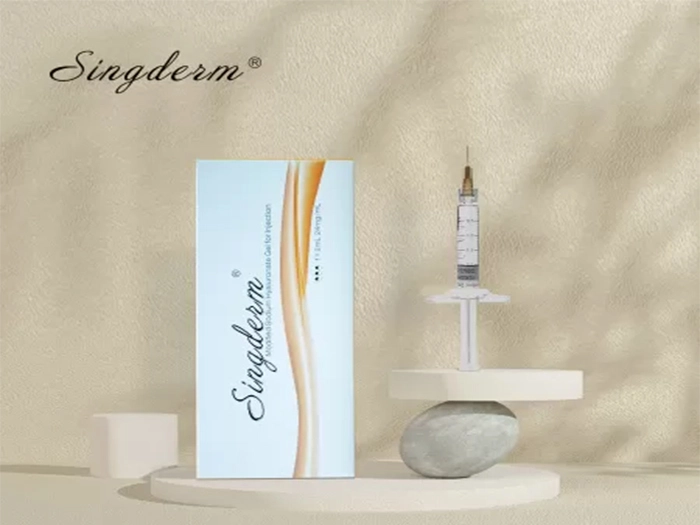
Hyaluronic acid (HA) has become one of the most widely used biomaterials in aesthetic medicine due to its excellent biocompatibility, water-retention capacity, and safety profile. Today, injectable hyaluronic acid fillers are widely used to restore facial volume, smooth wrinkles, and enhance facial contours with natural-looking results.
However, not all hyaluronic acid products are the same. One of the most important distinctions lies in whether the hyaluronic acid is cross-linked or non-cross-linked. Although both originate from the same naturally occurring molecule, they differ significantly in structure, durability, and clinical applications.
In this article, we'll explain the differences between cross-linked hyaluronic acid and non-cross-linked hyaluronic acid, discuss why cross-linked HA has become the gold standard for dermal fillers, and provide guidance on selecting the right product for aesthetic treatments.
Hyaluronic acid is a naturally occurring polysaccharide found throughout the human body, particularly in the skin, joints, connective tissues, and eyes. Its primary function is to retain moisture, lubricate tissues, and support skin elasticity.
One remarkable characteristic of hyaluronic acid is its ability to bind large amounts of water, helping the skin remain hydrated, smooth, and resilient. Because of its excellent biocompatibility and biodegradability, HA has become one of the safest and most versatile materials used in medical aesthetics.
However, natural hyaluronic acid is rapidly broken down by enzymes in the body. Without modification, it typically remains in the tissue for only a short period, limiting its effectiveness for long-term facial contouring or wrinkle correction.
To overcome this limitation, scientists developed cross-linking technology, significantly improving the performance and longevity of hyaluronic acid fillers.
The main difference between these two types of hyaluronic acid lies in their molecular structure.
Cross-linked hyaluronic acid is created by chemically connecting individual HA molecules using a cross-linking agent, most commonly BDDE (1,4-Butanediol Diglycidyl Ether). This process forms a stable three-dimensional network, making the gel more resistant to enzymatic degradation and allowing it to maintain volume for a much longer period.
In contrast, non-cross-linked hyaluronic acid retains its natural linear molecular structure. It is softer and spreads easily within tissues but is rapidly metabolized by the body, making it more suitable for hydration treatments than volumization.
| Feature | Cross-linked HA | Non-cross-linked HA |
|---|---|---|
| Molecular Structure | Three-dimensional network | Linear chain |
| Stability | High | Low |
| Longevity | Approximately 6–12 months | Weeks |
| Lifting Capacity | Excellent | Minimal |
| Primary Applications | Dermal fillers and facial contouring | Skin hydration, mesotherapy, skin boosters |
*The duration varies depending on the product formulation, treatment area, injection technique, and individual metabolism.
Simply put, cross-linking transforms hyaluronic acid from a short-acting moisturizer into a durable volumizing material capable of supporting facial structures.
Cross-linked hyaluronic acid has become the preferred material for modern hyaluronic acid dermal fillers because it offers several important clinical advantages.
First, it provides longer-lasting results. Thanks to its stable molecular network, cross-linked HA resists degradation much more effectively than non-cross-linked HA, allowing aesthetic results to last for months rather than weeks.
Second, it offers better lifting capacity. The enhanced elasticity and cohesivity of cross-linked gels help maintain facial contours and provide structural support in areas requiring volume restoration.
Third, cross-linked fillers deliver more precise contouring. They can effectively restore lost volume, define facial features, and improve overall facial harmony while maintaining a natural appearance.
These properties make cross-linked HA the preferred choice for treatments such as:
Wrinkle correction
Lip enhancement
Cheek augmentation
Chin projection
Nose reshaping
Jawline contouring
Facial volume restoration
Different treatment areas require fillers with different rheological properties, injection depths, and lifting capacities. Choosing the appropriate product helps practitioners achieve predictable and natural-looking outcomes.
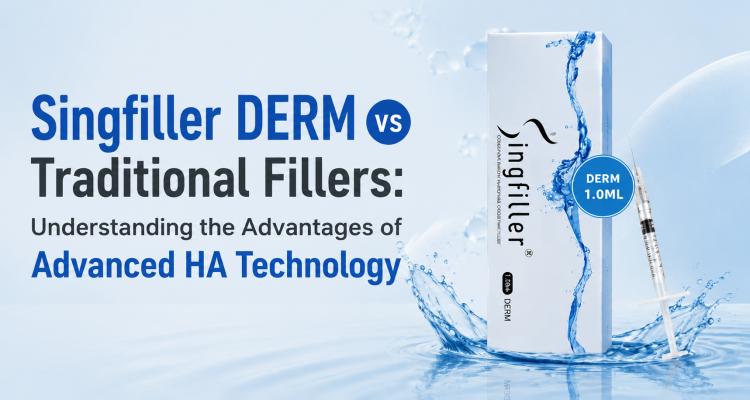
The Singfiller® product portfolio offers multiple formulations designed for different clinical indications.
| Treatment Area | Recommended Product |
| Fine lines and superficial wrinkles | Singfiller® Fine |
Forehead wrinkle, cheek, nasolabial folds | Singfiller® Derm |
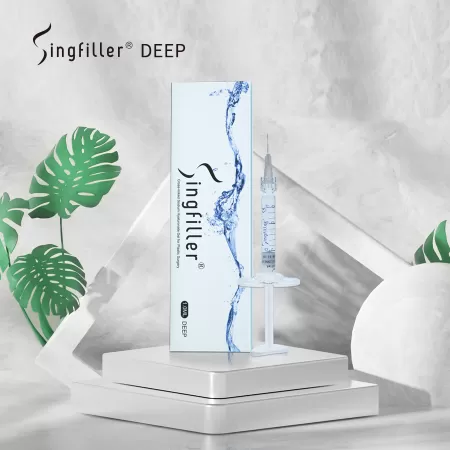
| Frontal bone, temple, zygomatic arch, nose, nasal base, jawline and chin | Singfiller® Deep |
| Advanced contouring of the temple, zygomatic arch, nose, nasal base, jawline and chin | Singfiller® Deeper |
| Breast and buttock augmentation | Singfiller® Sub-Q |
Each product is formulated with a different gel consistency and lifting capacity, allowing physicians to select the most appropriate filler according to the treatment indication and desired aesthetic outcome.
Not all cross-linked hyaluronic acid fillers offer the same level of performance. When selecting a product, physicians and distributors should evaluate several key factors.
HA Raw Material Quality
High-purity hyaluronic acid provides better consistency, safety, and biocompatibility.
Cross-linking Technology
Advanced cross-linking processes help optimize elasticity, cohesivity, and durability while maintaining a smooth injection experience.
Residual BDDE Level
A high-quality filler should contain minimal residual cross-linking agent after purification, supporting product safety.
Quality Certifications
International certifications such as CE and ISO 13485 demonstrate that the manufacturer follows recognized quality management standards.
Manufacturer Experience
Choosing an experienced dermal filler manufacturer ensures stable production quality, technical support, and reliable regulatory documentation for global distribution.
Both cross-linked and non-cross-linked hyaluronic acid play important roles in aesthetic medicine, but they are designed for different clinical purposes.
Non-cross-linked hyaluronic acid is ideal for improving skin hydration and supporting skin quality treatments, while cross-linked hyaluronic acid offers the durability, lifting capacity, and structural support required for facial rejuvenation and body contouring.
For practitioners, selecting the appropriate filler depends on the treatment area, desired aesthetic outcome, and product characteristics. For distributors and private-label brands, partnering with a trusted manufacturer is equally important.
Singfiller® offers a comprehensive portfolio of CE-certified cross-linked hyaluronic acid dermal fillers designed for a wide range of facial and body indications. Backed by advanced manufacturing technology and strict quality control, Singfiller® provides reliable solutions for aesthetic clinics, distributors, and OEM/ODM partners worldwide.
Whether you're looking for fillers for facial rejuvenation, contour enhancement, or body contouring, the Singfiller® portfolio offers tailored solutions to meet diverse clinical needs. Contact our team today to learn more about our products, OEM/ODM services, and global distribution opportunities.
 Call us on:
  Email Us:
  No. 125(E), 10th Street, Hangzhou Qiantang Area, Zhejiang, China