
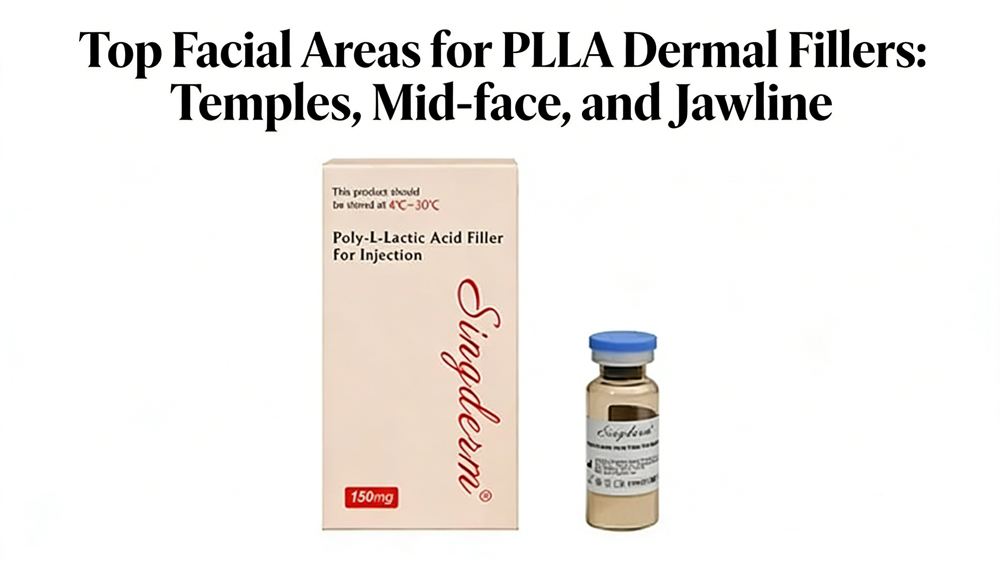
PLLA dermal fillers are most effective in facial areas where structural support and collagen regeneration are needed—particularly the temples, mid-face, and jawline. These regions experience significant age-related volume loss and skin laxity, making them ideal treatment zones for PLLA filler, which works by stimulating collagen production rather than simply providing immediate volume.
In clinical practice, these three facial areas consistently deliver the most predictable and long-lasting results when treated with plla dermal fillers, especially for patients seeking natural, progressive rejuvenation.
Unlike hyaluronic acid fillers that mainly restore volume through gel placement, PLLA filler (Poly-L-Lactic Acid) acts as a biostimulatory injectable. Once injected, PLLA microparticles trigger fibroblast activation, gradually stimulating collagen synthesis over several months.
This mechanism provides several advantages in structural areas of the face:
Gradual and natural-looking improvement
Long-term collagen remodeling
Enhanced skin thickness and elasticity
Reduced risk of overfilling compared with volumizing fillers
Because of these characteristics, aesthetic practitioners frequently select plla dermal fillers for areas requiring subtle contour restoration and structural reinforcement.
Temple hollowing is one of the earliest and most noticeable signs of facial aging. Loss of fat and bone support in this area can make the upper face appear skeletal or fatigued.
PLLA fillers work particularly well in the temples because they gradually rebuild volume through collagen regeneration rather than immediate gel expansion.
Clinical benefits include:
Restoration of temporal volume loss
Softening of skeletal contours
Improved upper facial balance
Natural blending with surrounding tissue
Since the temple region has relatively thin soft tissue, practitioners prefer biostimulatory fillers like PLLA that provide progressive correction rather than abrupt volume changes.
The mid-face, including the cheeks and malar region, is the primary support structure of the face. With aging, this area experiences:
Fat pad descent
Bone resorption
Collagen degradation
These changes contribute to flattened cheeks and deeper nasolabial folds.
When PLLA filler is injected into the mid-face, it stimulates collagen production within the dermis and subcutaneous layers. Over time, this process leads to:
Improved cheek projection
Increased dermal thickness
Reduced nasolabial fold prominence
Better facial contour harmony
Mid-face treatment with plla dermal fillers is often preferred for patients who want long-term structural improvement without frequent maintenance treatments.
The jawline plays a major role in facial definition. Aging typically causes:
Loss of mandibular contour
Skin laxity
Early jowl formation
PLLA fillers improve the jawline by stimulating collagen within the lower face. Over time, this leads to:
Stronger mandibular definition
Improved skin firmness
Reduced jowl appearance
Better transition between jawline and neck
Because the jawline benefits from gradual tightening rather than excessive filler volume, PLLA dermal fillers offer a balanced solution for subtle contour enhancement.
PLLA fillers typically produce long-lasting results because they stimulate collagen production rather than relying solely on filler volume.
Most patients experience improvements that last 18 to 24 months, although longevity may vary depending on:
Injection technique
Treatment area
Individual metabolism
Number of treatment sessions
Clinics often recommend a series of treatments spaced several weeks apart to achieve optimal collagen stimulation.
Both types of fillers have specific advantages depending on treatment goals.
Hyaluronic acid fillers provide immediate volume and are ideal for areas such as the lips or tear troughs.
PLLA dermal fillers, however, are better suited for structural facial areas because they:
Promote natural collagen production
Deliver longer-lasting results
Improve skin quality over time
For many practitioners, a combination of HA fillers for targeted correction and PLLA for structural rejuvenation produces the most balanced outcome.
Patients who benefit most from plla dermal fillers typically include those experiencing:
Early to moderate facial volume loss
Temple hollowing
Flattened cheeks
Jawline softening
Mild skin laxity
Because PLLA stimulates natural collagen production, it is also suitable for patients seeking gradual and subtle facial rejuvenation rather than immediate dramatic change.
Treatment plans vary depending on the patient’s age, skin condition, and aesthetic goals.
In most clinical settings, patients receive:
Two to three treatment sessions
Sessions spaced 4–6 weeks apart
This staged approach allows collagen regeneration to occur progressively, creating natural and long-lasting results.
PLLA has been used in medical applications for decades and is widely regarded as safe when administered by experienced practitioners.
Proper treatment protocols include:
Correct dilution and preparation
Appropriate injection depth
Even distribution of the product
Post-treatment massage to ensure uniform placement
Following these guidelines minimizes the risk of nodules and ensures optimal collagen stimulation.
As aesthetic medicine shifts toward regenerative approaches, PLLA filler treatments are becoming increasingly popular worldwide. Clinics are focusing more on therapies that stimulate the body’s own collagen production rather than relying solely on synthetic volume.
By targeting key structural areas such as the temples, mid-face, and jawline, plla dermal fillers provide a natural pathway to facial rejuvenation, improving both skin quality and contour over time.
For aesthetic clinics and distributors, PLLA represents an important category within the evolving market of biostimulatory dermal fillers, offering long-term results and high patient satisfaction.
 Call us on:
  Email Us:
  No. 125(E), 10th Street, Hangzhou Qiantang Area, Zhejiang, China