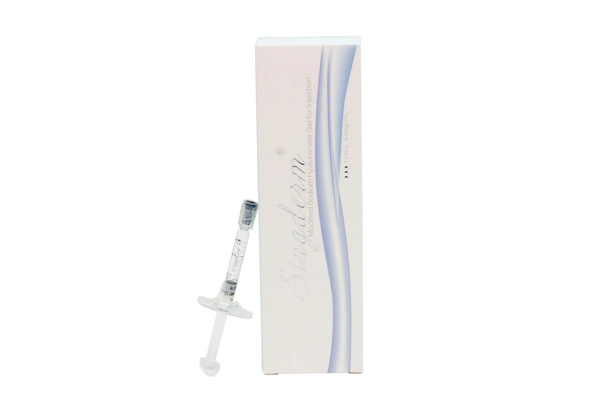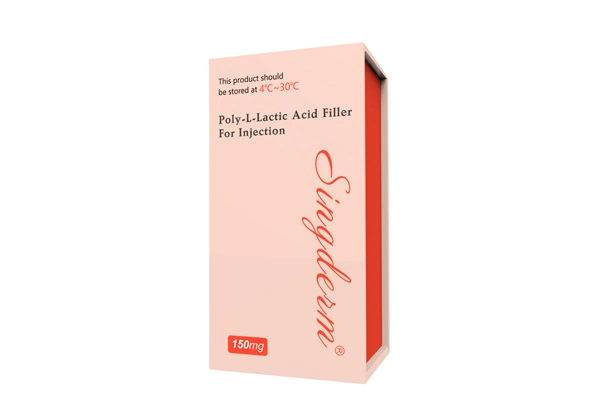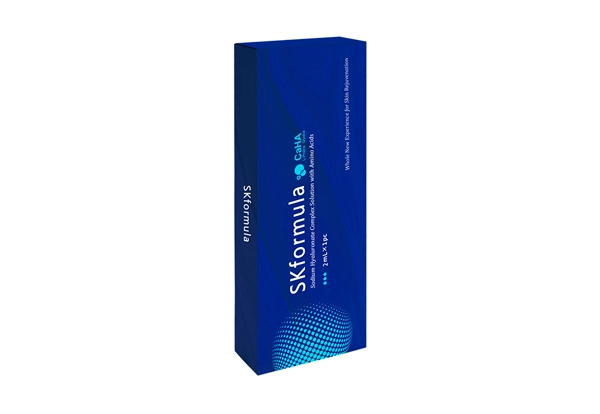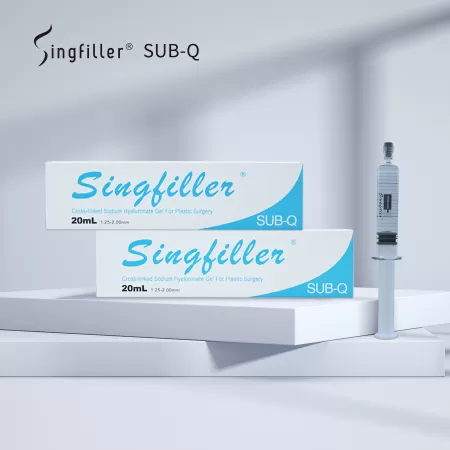

The performance of any HA lip filler is determined primarily by its G' (elasticity), viscosity, and cohesivity. These rheological properties directly affect lip volume, softness, contour precision, natural movement, and the risk of migration. High G' fillers provide structure and projection, while low G' fillers offer softness. Viscosity determines flow and injectability, and cohesivity determines how well the filler integrates with lip tissue.
Below is a detailed, expert-level breakdown intended for distributors, clinics, and aesthetic brands seeking deeper insight into filler selection and product-level differentiation.
Modern HA lip fillers are formulated using crosslinked hyaluronic acid, and their behavior inside the lips depends on three key properties:
How firm or "springy" the gel is.
High G' → Strong support, defined structure
Low G' → Softer, more flexible, more natural movement
How thick or resistant the gel is to flow.
High viscosity → Stays in place, good for definition
Low viscosity → Smooth spread, ideal for hydration and natural plumping
How well the particles hold together under stress.
High cohesivity → Maintains shape, reduced migration
Low cohesivity → Gentle blending, softer lips
Together, these properties determine injection feel, aesthetic output, and longevity—key considerations for B2B buyers choosing filler lines for different markets.
Younger patients often ask: "Which lip filler gives better shape?"
(From People Also Ask: Which filler is best for lip definition?)
Answer:
Lip definition relies heavily on moderate-to-high G' because it provides structure at the vermilion border.
High G' fillers help create sharp borders, a lifted Cupid's bow, and projection.
Low G' fillers give a soft, blended look ideal for hydration treatments.
Industry Insight:
Distributors should offer at least two G' levels for lip indications:
Soft G' for natural "K-beauty" style lip hydration
Firm G' for Western-style contour and volume
This segmentation increases sales across diverse markets.
(From People Also Ask: What makes lip filler look natural?)
Answer:
Natural-looking lips come from fillers with low-to-medium viscosity, which integrate seamlessly with lip mucosa and move naturally during speech.
High viscosity → Excellent control but may feel firm
Low viscosity → Soft, moldable, subtle
For fast-moving or humid markets (e.g., Korea, Singapore, Thailand), softer, more fluid fillers dominate because patients prefer hydrated, glossy lips rather than firm volume.
Industry Note:
When selling in markets with strong "natural results" demand, promote fillers with:
Smooth extrusion
Low injection resistance
Hydrating effect
(From People Also Ask: How do you prevent lip filler migration?)
Answer:
Migration prevention depends greatly on high cohesivity, which keeps gel particles tightly bound and anchored.
High cohesivity → Reduced migration, stable shape
Low cohesivity → Fluid but may disperse if injected too superficially
High cohesivity is particularly important in:
Lip borders
Cupid's bow
Vertical lip columns
Manufacturer Tip:
Strong cohesivity is achieved through controlled crosslinking density and uniform HA particle distribution—features distributors should highlight to clinics concerned about migration.
Low G'
Low viscosity
High cohesivity
Perfect for:
First-time filler users
Younger demographics
Asian markets preferring subtle results
Medium-to-high G'
Medium viscosity
Medium/high cohesivity
Perfect for:
Cupid's bow lift
Contour refinement
Sharper lip edges
High G'
High viscosity
High cohesivity
Perfect for:
Upper lip lift
Plump, structured volume
"Augmented" lip look
Distributor Insight:
Offering a multi-grade lip filler series aligned to these goals makes your product line adaptable and globally competitive.
Choosing the right HA lip filler depends on the patient's aesthetic goal and the filler's rheology:
| Goal | Best G’ | Best Viscosity | Best Cohesivity |
Natural, subtle | Low | Low | High |
Structured & defined | Medium–High | Medium | Medium–High |
Maximum volume | High | High | High |
Clinics prefer brands that provide clear rheology data, so distributors who offer this transparency gain an edge.
Higher G' → Longer structural support
Higher viscosity → Slower tissue dispersion
Higher cohesivity → Reduced metabolization
This explains why firmer fillers used for projection may last 9–12 months, while soft fillers for hydration last 4–6 months.
1. Better portfolio positioning
Match specific filler models to local market trends.
2. Improved clinic training
Clinics want clear explanations of why one filler performs differently from another.
3. Stronger technical value proposition
Clinics prefer suppliers who can explain:
G' data
Viscosity curves
Cohesivity tests
Crosslinking details
4. Higher conversion rate
Clear product specifications = higher buyer trust.
The success of any HA lip filler in clinical practice depends largely on G', viscosity, and cohesivity—three rheological parameters that control shape, softness, migration resistance, and longevity.
For distributors, understanding and articulating these technical differences helps position your filler line more effectively, improve clinic relationships, and increase product adoption in growing lip filler markets worldwide.
Low-viscosity, low-G' fillers with high cohesivity provide soft, hydrated, natural-looking lips.
Medium-to-high G' HA fillers that maintain structure and support border definition.
Use high-cohesivity fillers, inject deep enough, avoid overfilling, and select gels with stable crosslinking.
Typically 4–12 months depending on rheology and injection depth.
The patient's goal + filler's G', viscosity, cohesivity, and brand formulation technology.
 Call us on:
  Email Us:
  No. 125(E), 10th Street, Hangzhou Qiantang Area, Zhejiang, China