
In the professional aesthetics industry, PDRN and HA skin boosters have emerged as two of the most sought-after injectable treatments for skin rejuvenation and repair. While both aim to improve skin elasticity, texture, and hydration, their mechanisms and biological effects differ significantly.
As a manufacturer and wholesale supplier in the dermal aesthetics field, we often receive inquiries from distributors and clinics asking: Which is better for collagen stimulation and overall skin regeneration — PDRN or HA?
Let's break it down from a clinical performance and product development standpoint.
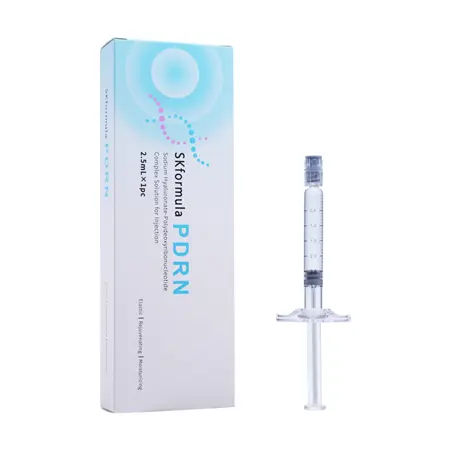
Both PDRN and HA-based skin boosters contribute to skin revitalization, but their core benefits target different layers and biological pathways:
PDRN Skin Booster Injection: Excels at cellular repair and collagen regeneration through DNA-based bioactivation.
HA Skin Booster: Specializes in deep hydration and volumization, improving elasticity and glow through moisture retention.
In short, HA focuses on immediate hydration and plumping, while PDRN works on long-term skin healing and structural repair. The best choice often depends on the patient’s skin condition and the treatment goal.
PDRN (Polydeoxyribonucleotide) is a DNA polymer extracted from salmon or trout sperm cells, known for its remarkable regenerative properties. It stimulates fibroblast proliferation, angiogenesis, and collagen synthesis, making it ideal for repairing damaged or aging skin.
Mechanism of Action:
Activates A2A adenosine receptors, reducing inflammation and promoting tissue repair.
Enhances fibroblast activity, accelerating collagen and elastin production.
Improves microcirculation and cell metabolism, promoting faster healing.
Clinical Advantages:
Encourages deep dermal regeneration.
Reduces fine lines and acne scars.
Restores elasticity and skin thickness.
Compatible with mesotherapy or microinjection protocols.
From a formulation standpoint, PDRN boosters often include HA or peptides, enhancing their bioactivity and commercial value.
Hyaluronic Acid (HA) remains the gold standard in skin hydration and volume restoration. It's a naturally occurring polysaccharide capable of retaining up to 1,000 times its weight in water.
Mechanism of Action:
Binds water molecules to hydrate the extracellular matrix.
Improves turgidity, smoothness, and radiance of the skin.
Provides immediate volume and plumping effect.
Clinical Advantages:
Quick visible improvement.
Minimal downtime, widely accepted by practitioners.
Versatile use for fine lines, under-eye areas, and dull skin.
Unlike PDRN, however, HA does not directly stimulate fibroblast activity or promote collagen synthesis. Its benefits are primarily hydrodynamic and structural.
| Parameter | PDRN Skin Booster Injection | HA Skin Booster |
Primary Function | Skin repair & regeneration | Deep hydration |
Mechanism | DNA bioactivation & collagen stimulation | Water retention & moisture balance |
Duration of Effect | 3–6 months (cumulative benefits) | 4–9 months (instant effect) |
Ideal Indications | Aging, scarring, photo-damage | Dehydration, dullness, fine lines |
Injection Depth | Dermis or subdermis | Superficial to mid-dermis |
Key Benefit | Long-term skin renewal | Immediate plump and glow |
From a product development perspective, PDRN-based boosters offer more potential for bioregenerative branding—an area of rapid growth in medical aesthetics.
The global trend toward bioactive injectables is shifting focus from short-term correction to skin healing and longevity. PDRN represents this transition.
Advantages Over Conventional Boosters:
Regenerative action: Stimulates DNA repair and dermal fibroblast activation.
Anti-inflammatory effect: Reduces post-procedure redness and irritation.
Enhanced wound recovery: Ideal for post-laser or post-acne treatments.
Synergistic potential: Often combined with HA, peptides, or glutathione for multi-functional formulations.
For distributors and OEM partners, PDRN skin booster injection lines are a high-value product segment—especially appealing in Asia, Europe, and the Middle East, where regenerative aesthetics are trending.
To bridge the performance gap, many manufacturers now develop hybrid boosters combining PDRN and HA.
These formulations deliver instant hydration from HA and cellular repair from PDRN, providing both short-term glow and long-term rejuvenation.
Technical Insight for Buyers:
When evaluating hybrid boosters, focus on:
PDRN concentration: Usually 0.5%–1% for optimal stimulation.
HA molecular weight: Low-to-medium weight HA ensures smoother injection and better dispersion.
pH and osmolarity: Balanced formulation reduces irritation and inflammation risk.
Such dual-action boosters represent the most commercially successful injectable subcategory in the regenerative market today.
In high-performance injectables, source purity and molecular stability determine both safety and efficacy.
PDRN Sourcing: Must be DNA-fragmented through controlled enzymatic hydrolysis, ensuring a molecular size of 50–1500 kDa for cellular uptake.
HA Crosslinking Technology: Should maintain optimal viscoelasticity while preserving biocompatibility.
Sterilization Process: Gamma sterilization or aseptic filtration must retain molecular integrity.
For wholesale buyers and distributors, it's essential to partner with manufacturers who can provide GMP-certified facilities, stability data, and clinical documentation supporting collagen stimulation and dermal repair claims.
According to market trends, PDRN-based injectables are among the fastest-growing product segments in medical aesthetics—especially in Korea, China, and Southeast Asia. The rising popularity stems from:
A shift toward non-surgical regenerative therapies.
Increased consumer awareness of cell-repair-focused treatments.
Strong clinical outcomes with minimal side effects.
From a B2B perspective, stocking or private-labeling PDRN skin booster injections offers a strong return on investment, particularly for distributors serving dermatology clinics, medspas, and anti-aging centers.
If the goal is deep collagen stimulation, wound recovery, and anti-aging from within, PDRN boosters clearly outperform HA-based ones.
However, HA boosters still hold a vital position for immediate volume correction and hydration-focused treatments. The most effective clinical strategy often involves combining both—starting with PDRN sessions to rebuild the dermis, followed by HA boosters for surface luminosity.
For wholesalers and OEM clients, offering a diversified product portfolio—including both PDRN and HA boosters—ensures comprehensive market coverage and stronger distributor competitiveness.
Both PDRN skin booster injections and HA skin boosters have essential roles in professional skin rejuvenation. But when it comes to collagen stimulation and tissue repair, PDRN leads as the regenerative powerhouse, actively promoting cellular renewal and dermal reconstruction.
Clinics seeking to move beyond hydration and enter the bio-regenerative filler market should prioritize PDRN-based or hybrid PDRN + HA boosters. For manufacturers and distributors, this category represents one of the most profitable and future-proof sectors in medical aesthetics.
1. Is PDRN suitable for all skin types?
Yes, it's highly biocompatible and safe for sensitive or damaged skin.
2. How many sessions are needed for visible results?
Typically 3–4 sessions at 2–3 week intervals, depending on skin condition.
3. Can PDRN boosters be combined with other treatments?
Yes. They're often paired with microneedling, laser, or HA injections for synergistic rejuvenation.
4. What's the shelf life of PDRN skin booster injections?
Generally 24–36 months under proper storage conditions (2–25°C, protected from light).
5. Why should distributors add PDRN boosters to their catalog?
They offer strong clinical efficacy, increasing global demand, and align with the industry's shift toward regenerative aesthetics—making them a strategic addition for long-term business growth.
 Call us on:
  Email Us:
  No. 125(E), 10th Street, Hangzhou Qiantang Area, Zhejiang, China