
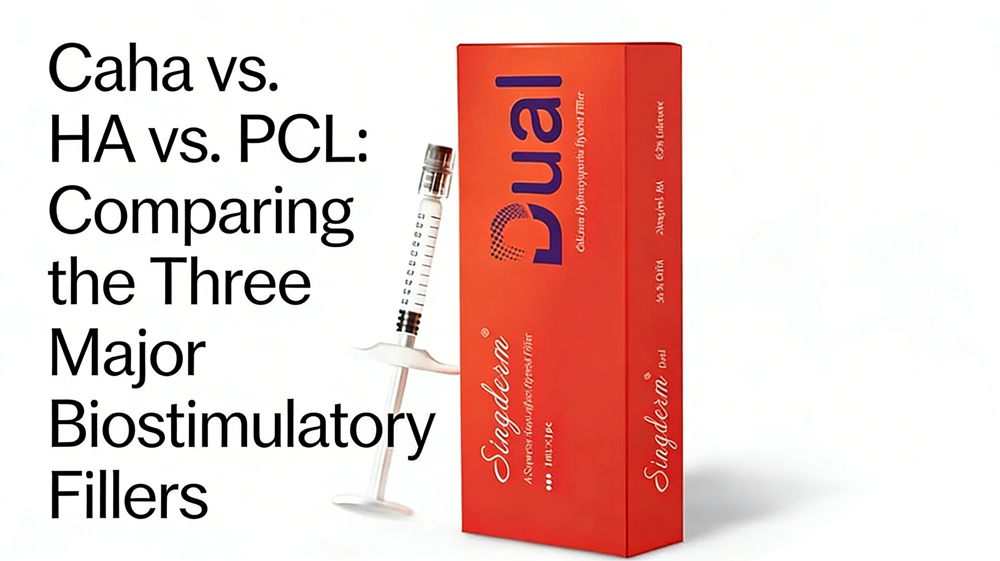
Modern injectable aesthetics increasingly focuses on biostimulatory fillers that not only restore volume but also stimulate collagen production and improve long-term skin quality. Among the most widely used materials are calcium hydroxylapatite (CaHA), hyaluronic acid (HA), and polycaprolactone (PCL). Each filler category offers distinct advantages depending on treatment goals, longevity expectations, and clinical indications.
For aesthetic clinics and distributors evaluating injectable product portfolios, understanding how these materials differ in mechanism of action, durability, and treatment applications is essential. While HA remains the most commonly used filler globally, calcium hydroxylapatite filler and PCL are gaining attention due to their stronger collagen-stimulating capabilities.
Biostimulatory fillers enhance facial rejuvenation through two mechanisms:
Immediate volumization from the filler material itself
Gradual collagen stimulation triggered by the filler particles
The body responds to these materials by activating fibroblasts, which produce collagen and elastin. Over time, this biological response improves skin firmness, elasticity, and structural support.
However, each filler type achieves this effect through different material properties.
A calcium hydroxylapatite filler contains microspheres composed of calcium and phosphate minerals suspended in a gel carrier. These minerals closely resemble components naturally found in human bone and teeth.
When a calcium hydroxylapatite injection is administered into the dermis or subdermal layer, it produces:
Immediate volume correction
Collagen stimulation over time
Improved skin firmness and structure
Once the gel carrier is gradually absorbed, the CaHA microspheres continue to stimulate collagen production, leaving behind newly formed tissue that supports long-lasting rejuvenation.
Clinically, calcium hydroxylapatite injections are frequently used for:
Jawline contouring
Chin augmentation
Nasolabial folds
Hand rejuvenation
Skin tightening with diluted formulations
Because CaHA provides structural support, it is often preferred in areas requiring strong lifting capacity.
Hyaluronic acid fillers are the most widely used injectable aesthetic products due to their versatility and safety profile.
HA fillers work by binding water molecules within the dermis, creating:
Immediate volume restoration
Improved hydration
Smoother skin texture
Unlike CaHA or PCL, HA primarily functions as a volumizing filler, although some formulations also stimulate mild collagen production.
Immediate visible results
Reversible with hyaluronidase
Highly adaptable for different facial areas
Excellent safety profile
For these reasons, HA fillers are often used for lips, tear troughs, and superficial wrinkles, where softer filler characteristics are required.
Polycaprolactone (PCL) is a biodegradable polymer used in long-lasting dermal fillers designed for collagen stimulation.
PCL fillers consist of microscopic spheres suspended in a carrier gel. After injection, the gel provides immediate volume while the PCL particles gradually stimulate fibroblasts.
This process results in:
Progressive collagen production
Improved skin elasticity
Long-term structural support
Compared with other filler materials, PCL offers some of the longest-lasting results in biostimulatory injectables.
PCL fillers are often used for:
Deep facial folds
Cheek augmentation
Jawline contouring
Structural facial rejuvenation
Because of their durability, PCL fillers are generally used in areas requiring long-term structural support.
Longevity varies based on formulation, injection technique, and patient metabolism.
Typical duration ranges include:
HA fillers: 6–12 months
Calcium hydroxylapatite filler: 12–18 months
PCL fillers: up to 2–4 years depending on formulation
The extended longevity of PCL and CaHA fillers makes them attractive for patients seeking long-term collagen stimulation and structural improvement.
Safety is an important consideration when selecting injectable treatments.
Calcium hydroxylapatite injections have been widely used in medical and aesthetic applications for many years. Because the material closely resembles naturally occurring minerals in the body, it is generally well tolerated.
When administered by trained professionals, CaHA fillers demonstrate:
High biocompatibility
Low allergic reaction rates
Predictable treatment outcomes
Proper injection depth and technique remain essential to ensure optimal results and minimize complications.
Among the three options, both CaHA and PCL fillers are considered strong collagen stimulators.
Calcium hydroxylapatite filler: stimulates collagen through mineral microspheres that act as a scaffold for new tissue growth
PCL filler: stimulates collagen via biodegradable polymer particles that gradually break down over time
HA fillers provide mild collagen stimulation but are primarily used for hydration and volume correction rather than long-term regenerative effects.
Clinicians often select calcium hydroxylapatite injection treatments when structural support and lifting capacity are required.
CaHA fillers are particularly suitable for:
Facial contouring
Jawline definition
Chin projection
Skin tightening treatments using diluted techniques
Compared with HA, CaHA offers stronger structural support. Compared with PCL, it provides similar collagen stimulation but typically with a shorter duration.
The global aesthetics market is increasingly shifting toward regenerative treatments rather than simple volume replacement. Patients are seeking procedures that improve:
Skin quality
Collagen production
Long-term facial structure
As a result, materials such as calcium hydroxylapatite filler, polycaprolactone, and other biostimulatory injectables are gaining popularity among practitioners worldwide.
Clinics often combine different fillers in a treatment strategy, using HA for immediate correction and CaHA or PCL for long-term structural rejuvenation.
Each major filler category—HA, CaHA, and PCL—plays a unique role in modern aesthetic medicine.
Hyaluronic acid fillers remain the most versatile option for hydration and volume restoration.
Calcium hydroxylapatite filler provides strong structural support and reliable collagen stimulation.
PCL fillers offer long-lasting regenerative effects and extended durability.
Understanding these differences helps practitioners select the most appropriate treatment approach for each patient and allows distributors to build balanced injectable portfolios that meet the evolving demand for biostimulatory dermal fillers.
 Call us on:
  Email Us:
  No. 125(E), 10th Street, Hangzhou Qiantang Area, Zhejiang, China