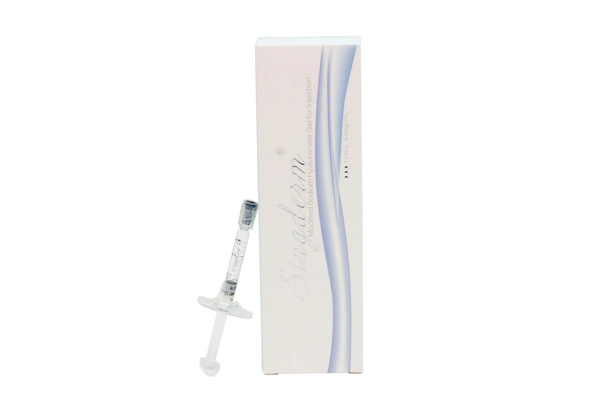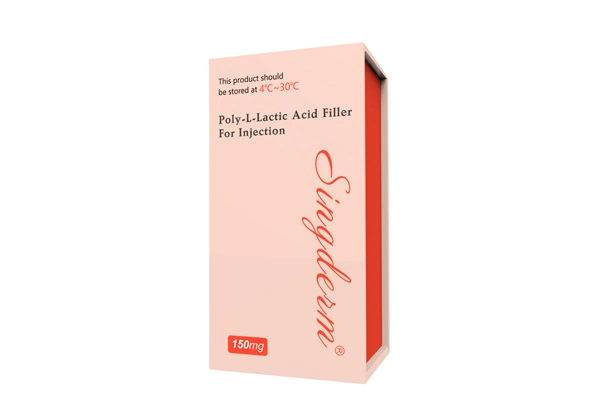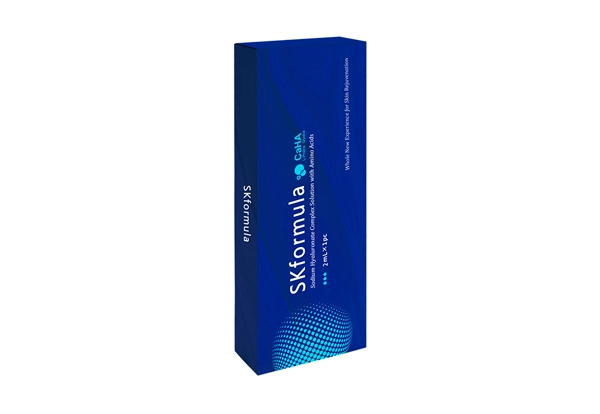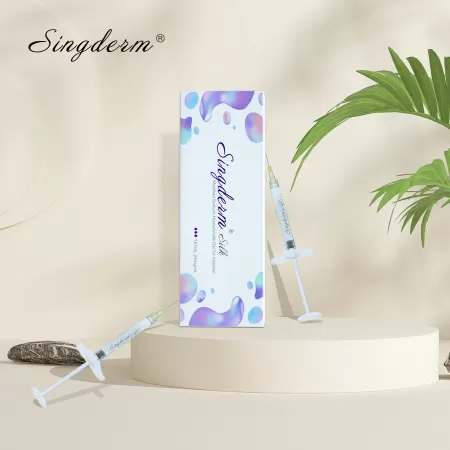

In the ever-evolving aesthetics industry, hybrid dermal fillers have become one of the most talked-about innovations among manufacturers, distributors, and professional injectors. These formulations combine two or more active biocompatible materials—typically Hyaluronic Acid (HA) with stimulatory agents like Poly-L-Lactic Acid (PLLA) or Calcium Hydroxylapatite (CaHA)—to deliver both immediate correction and long-term skin rejuvenation.
As demand for high-performance, multifunctional fillers rises, understanding the composition, performance, and commercial potential of these hybrid solutions becomes crucial for buyers and industry professionals.
Traditional fillers, such as HA-based gels, offer instant volume restoration and hydration but typically last 6–12 months. On the other hand, collagen stimulators like PLLA or CaHA induce neocollagenesis, leading to gradual and sustained results.
A hybrid dermal filler merges these benefits: the HA component provides immediate volumizing and hydration effects, while the stimulatory polymer encourages collagen production for extended durability and improved skin texture over time.
This combination delivers both instant gratification and biological longevity, making it a valuable product type for both patients and practitioners seeking natural yet lasting outcomes.
From a manufacturer and distributor's viewpoint, hybrid fillers are strategically positioned in the premium segment due to:
Enhanced performance: Dual-action mechanism (instant fill + long-term stimulation).
Longer duration: Results can extend beyond 18–24 months.
Higher perceived value: Clinics and professionals are willing to pay more for visible, enduring outcomes.
Wider patient appeal: Suitable for those seeking natural results without repeated top-ups.
Global market data also shows an increasing demand for next-generation fillers that combine regenerative technology with traditional HA-based products.
This hybrid combines Hyaluronic Acid with Poly-L-Lactic Acid, one of the most advanced and sought-after formulations today.
Mechanism:
HA delivers instant plumping and moisture retention.
PLLA gradually stimulates fibroblast activity to produce collagen, enhancing firmness over time.
Benefits:
Immediate volume correction.
Progressive improvement in skin elasticity and density.
Reduced frequency of reinjection compared to HA-only fillers.
Considerations for Buyers:
PLLA-HA fillers require advanced production techniques to ensure homogeneous dispersion of microspheres and stable rheological properties. For distributors, quality consistency and regulatory compliance (CE, ISO, KFDA, or NMPA certifications) are key differentiators when sourcing suppliers.

CaHA is another well-known biostimulatory material, composed of microspheres suspended in a gel carrier.
Mechanism:
HA ensures smooth injectability and instant correction.
CaHA triggers long-term collagen remodeling through a controlled inflammatory response.
Benefits:
Firm lifting effect and longer-lasting results (24 months).
Excellent for contouring applications such as jawline or cheek enhancement.
Natural degradation profile; CaHA microspheres are fully resorbed by the body.
Industrial Insight:
HA-CaHA hybrids are relatively more complex to manufacture due to particle stabilization challenges. However, their high patient satisfaction rate makes them a profitable product line for wholesalers and private-label brands.
The hybrid filler category is continuously expanding. Some new formulations being explored include:
HA + PCL (Polycaprolactone): Offers ultra-long duration (up to 2 years) and promotes type I collagen synthesis.
HA + Peptides or Growth Factors: Aimed at skin revitalization and anti-aging synergy.
HA + PRP (Platelet-Rich Plasma): Though more of a procedural mix than a prefilled product, this combination is trending in regenerative clinics.
From a business perspective, these emerging hybrids represent future growth segments—especially in Asian and European markets, where natural rejuvenation and longevity are top consumer priorities.
Manufacturing hybrid fillers demands high-precision formulation control. Key technical considerations include:
Particle size uniformity: Essential for stable injection performance and safety.
Crosslinking balance: Too strong leads to stiffness; too weak causes rapid degradation.
Homogeneous dispersion: Ensures consistent performance throughout the syringe.
Sterilization process: Must not alter polymer integrity.
Buyers should always evaluate Rheological parameters (G', viscosity, cohesivity) and biocompatibility data before finalizing supply agreements.
For importers, wholesalers, and private-label brands, hybrid fillers represent a premium segment with higher margins. The key advantages include:
Product differentiation: Hybrid formulations stand out in a saturated HA filler market.
Brand positioning: Enables labeling as "regenerative," "dual-action," or "next-generation" solutions.
Cross-market adaptability: Applicable in both aesthetic and anti-aging medicine sectors.
Collaborating with a reliable OEM/ODM manufacturer capable of custom crosslinking ratios, microsphere sizes, and HA concentrations allows businesses to tailor products for specific market demands.
Given the complexity of hybrid materials, regulatory clearance varies by region.
In Europe, CE-marked hybrid fillers must demonstrate long-term biocompatibility and absence of delayed inflammatory reactions.
In Asia, KFDA and NMPA-approved PLLA-HA fillers are gaining rapid traction.
In the U.S., CaHA (Radiesse) and PLLA (Sculptra) are FDA-approved as single components, but hybrids are still emerging under investigational pathways.
For distributors, ensuring transparent documentation and quality assurance certificates is vital for smooth importation and clinic adoption.
The hybrid filler trend marks a turning point in the aesthetics market—bridging short-term cosmetic improvement with long-term skin regeneration. Whether it's HA + PLLA for progressive rejuvenation or HA + CaHA for structure and lift, these advanced formulations deliver unmatched value to clinics and distributors seeking innovation-driven products.
Understanding their mechanisms, market positioning, and quality parameters allows professionals to make smarter sourcing decisions and strengthen their competitive edge in the global filler supply chain.
1. What is the main advantage of hybrid dermal fillers over traditional HA fillers?
They combine immediate volume with long-term collagen stimulation, extending the lifespan and overall aesthetic quality of the results.
2. How long does a PLLA HA filler typically last?
Results can last 24 months, depending on formulation quality and injection depth.
3. Are hybrid fillers suitable for all skin types?
Yes, but injection protocols should be adjusted based on patient age, skin thickness, and aesthetic goals.
4. Which combination offers the firmest lifting effect?
HA + CaHA hybrids are preferred for lifting and contouring due to CaHA's structural properties.
5. What should distributors look for when sourcing hybrid dermal fillers?
Reliable manufacturing certification, clinical safety data, consistent rheology, and strong OEM/ODM capability.
 Call us on:
  Email Us:
  No. 125(E), 10th Street, Hangzhou Qiantang Area, Zhejiang, China