
Unlike conventional dermal fillers that primarily replace lost volume, poly L lactic acid fillers work by stimulating the body's own collagen production. As one of today's most widely adopted PLLA collagen stimulator technologies, they provide gradual, long-lasting facial rejuvenation by rebuilding the skin's structural foundation.
For aesthetic clinics and medical distributors, understanding the biological and clinical advantages of injectable poly L lactic acid helps explain why demand for collagen biostimulators continues to grow worldwide.
The primary mechanism of poly L lactic acid injection is collagen biostimulation rather than immediate volumization.
Following treatment, biodegradable PLLA microparticles trigger a controlled foreign-body response that activates fibroblasts. Over the following weeks and months, fibroblasts synthesize new Type I collagen, gradually rebuilding the extracellular matrix (ECM) and restoring dermal support.
Clinical studies have demonstrated progressive collagen remodeling for several months after treatment, allowing aesthetic improvements to continue long after the injection procedure.
Key clinical advantages include:
Increased Type I collagen synthesis
Improved extracellular matrix integrity
Enhanced dermal thickness
Better skin structural support
Progressive tissue regeneration
Unlike temporary fillers that disappear once the gel is absorbed, newly generated collagen becomes part of the patient's own tissue.
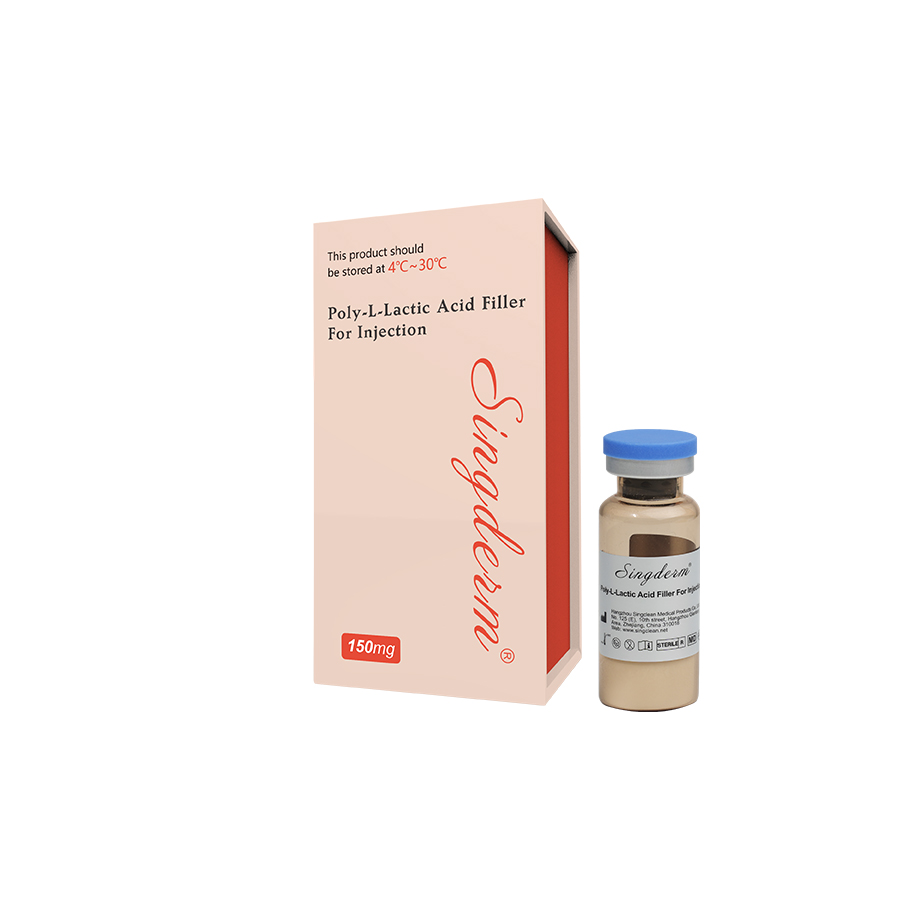
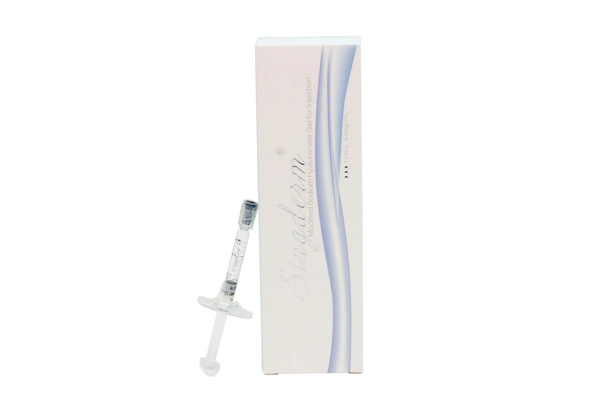
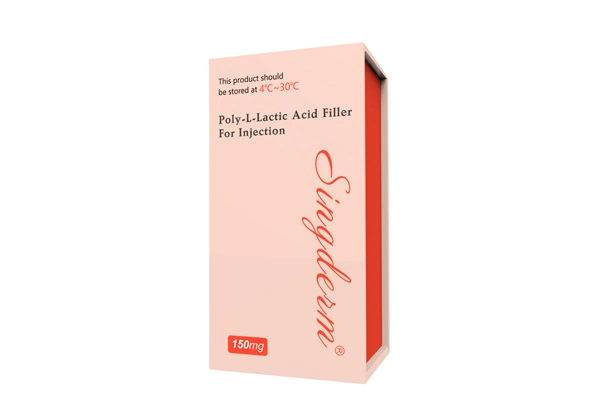
Singderm Injectable PLLA Filler
One of the biggest reasons physicians increasingly recommend poly L lactic acid fillers is the natural appearance they create.
Rather than producing instant volume expansion, collagen develops gradually over multiple treatment sessions. Patients experience progressive improvements in facial contour, skin firmness, and volume restoration without the overfilled appearance sometimes associated with traditional fillers.
This gradual transformation aligns with the growing trend toward regenerative aesthetics, where treatment focuses on restoring youthful tissue biology instead of simply filling wrinkles.
Durability is one of the strongest competitive advantages of injectable poly L lactic acid.
Although PLLA particles are gradually metabolized through normal physiological pathways into carbon dioxide and water, the collagen generated during treatment remains within the tissue.
Published clinical studies have reported aesthetic improvements lasting up to two years or longer after a complete treatment protocol, making PLLA one of the longest-lasting collagen-stimulating injectable materials available today.
For clinics, longer-lasting outcomes may improve patient satisfaction while reducing the frequency of maintenance treatments.
Unlike fillers designed only to occupy space, PLLA collagen stimulators improve multiple dimensions of skin quality through biological remodeling.
As collagen density increases, patients commonly experience improvements in:
Skin firmness
Elasticity
Dermal thickness
Skin texture
Fine lines
Facial contour definition
Overall skin quality
These improvements result from regeneration of the extracellular matrix rather than mechanical filling alone, making PLLA particularly attractive for patients seeking comprehensive facial rejuvenation.
Age-related collagen loss affects the entire face rather than isolated wrinkles.
Because collagen production occurs throughout the treated tissue, poly L lactic acid injection enables gradual restoration in multiple anatomical regions, including:
Temples
Mid-face
Cheeks
Jawline
Marionette lines
Preauricular area
Overall facial contours
Instead of creating isolated correction points, PLLA supports balanced, full-face rejuvenation that preserves natural facial expressions.
Modern aesthetic practices increasingly combine regenerative injectables with other minimally invasive procedures to achieve more comprehensive outcomes.
Poly L lactic acid fillers are frequently incorporated into combination protocols alongside:
Hyaluronic acid dermal fillers
Botulinum toxin
Skin boosters
Radiofrequency treatments
Microneedling
Fractional laser resurfacing
Ultrasound-based skin tightening
This multimodal approach enables clinicians to address dynamic wrinkles, volume loss, collagen depletion, and skin quality simultaneously while maintaining a natural aesthetic result.
Poly-L-lactic acid has been used safely in absorbable medical devices for decades, providing a well-established safety profile.
After injectable poly L lactic acid is administered, the microparticles gradually biodegrade through natural metabolic pathways and are ultimately eliminated as carbon dioxide and water. The material does not remain permanently within the body.
When injected using appropriate techniques by qualified medical professionals and followed by recommended post-treatment massage protocols, PLLA demonstrates a favorable safety profile that has supported its widespread adoption in regenerative aesthetic medicine.
Growing patient interest in natural, long-lasting rejuvenation is driving rapid adoption of PLLA collagen stimulators across aesthetic practices worldwide.
Compared with treatments that provide only temporary volume replacement, regenerative injectables offer a fundamentally different approach by encouraging the body to rebuild its own collagen framework.
As a result, more patients are seeking treatments that:
Deliver gradual, natural-looking rejuvenation
Improve skin quality as well as facial volume
Support healthy aging through collagen regeneration
Require fewer maintenance treatments over time
Produce long-lasting, clinically proven outcomes
For distributors, aesthetic clinics, and medical professionals, poly L lactic acid fillers represent one of the fastest-growing categories in regenerative aesthetics, combining established clinical evidence, durable results, and increasing patient demand.
 Call us on:
  Email Us:
  No. 125(E), 10th Street, Hangzhou Qiantang Area, Zhejiang, China