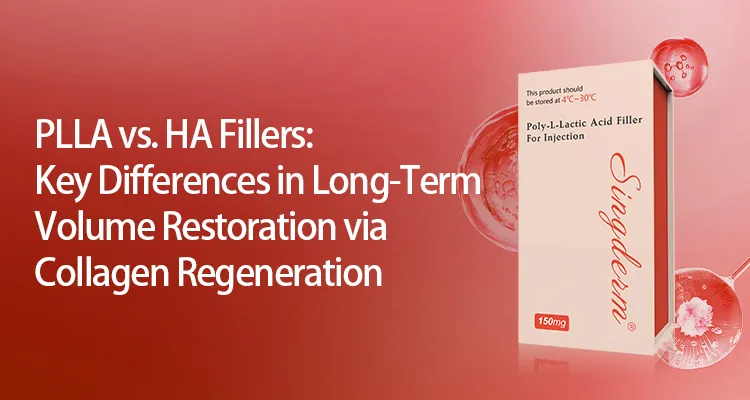

The medical aesthetics industry is entering a new era. While traditional dermal fillers have successfully addressed facial volume loss for decades, today's patients—and aesthetic practitioners—are seeking more than immediate correction. They want treatments that not only restore youthful contours instantly but also improve skin quality over time.
This shift has accelerated the development of hybrid dermal fillers, an innovative category of injectable products that combine the benefits of different biomaterials into a single treatment.
Among these innovations, PLLA HA fillers have emerged as one of the most promising solutions. By integrating cross-linked hyaluronic acid (HA) with poly-L-lactic acid (PLLA), hybrid fillers offer two complementary mechanisms:
Immediate volume enhancement through HA
Progressive collagen regeneration through PLLA
Instead of choosing between instant results or long-term rejuvenation, practitioners can now deliver both in a single injection.
For aesthetic clinics, distributors, and healthcare professionals, hybrid fillers represent more than a product upgrade—they represent the future direction of regenerative aesthetics.
Facial aging is a complex biological process. It involves much more than the loss of soft tissue volume.
As we age, patients experience:
Progressive collagen depletion
Reduced skin elasticity
Decreased dermal hydration
Fat pad displacement
Bone resorption
Declining fibroblast activity
Although conventional hyaluronic acid fillers remain the gold standard for immediate volume restoration, they primarily function as space-occupying materials. Once the HA gradually degrades, treatment results diminish, often requiring repeated maintenance injections.
On the other hand, collagen biostimulators such as PLLA activate fibroblasts to produce new collagen. While they deliver long-lasting improvement, patients generally wait several weeks—or even months—to appreciate visible results.
This difference creates a common clinical challenge.
Patients want immediate improvement.
Clinics want durable outcomes.
Practitioners prefer fewer treatment sessions with higher patient satisfaction.
Traditional filler technologies often require choosing one advantage at the expense of another.
That limitation has driven the industry toward a new generation of regenerative injectable materials.
The development of injectable fillers has progressed through several distinct stages.
The earliest fillers primarily focused on replacing lost facial volume.
Treatment goals included:
Filling wrinkles
Correcting folds
Restoring contour
Improving facial symmetry
Success was measured by how much volume could be restored immediately after treatment.
The next evolution introduced materials capable of stimulating collagen production.
Products containing PLLA or calcium hydroxyapatite (CaHA) shifted attention from simple filling toward biological tissue remodeling.
These injectables offered:
Improved longevity
Gradual skin tightening
Natural tissue regeneration
However, patients often needed multiple treatment sessions before seeing optimal outcomes.
Today, aesthetic medicine is moving toward hybrid fillers, combining different biomaterials into one injectable system.
Rather than replacing one technology with another, hybrid fillers integrate complementary mechanisms to maximize clinical performance.
For example, combining cross-linked hyaluronic acid with PLLA microspheres creates a filler capable of:
Delivering immediate facial contour improvement
Maintaining hydration within treated tissues
Stimulating collagen synthesis over time
Producing more natural-looking, progressive rejuvenation
This combination aligns perfectly with the growing demand for regenerative aesthetics, where treatment focuses not only on correcting aging but also on restoring the skin's biological function.
A hybrid dermal filler combines two or more biomaterials with different therapeutic mechanisms into a single injectable product.
Unlike conventional fillers that rely on only one active ingredient, hybrid fillers are designed to provide multiple benefits simultaneously.
In the case of HA + PLLA hybrid fillers, each component plays a distinct yet complementary role.
Cross-linked hyaluronic acid provides:
Immediate volume restoration
Facial contour enhancement
Excellent tissue integration
Deep hydration
Smooth injection characteristics
Patients notice visible improvement immediately after treatment.
PLLA functions differently.
Rather than acting solely as a filler, PLLA serves as a collagen biostimulator.
Following implantation, PLLA microspheres gradually activate fibroblasts, encouraging the production of new collagen fibers over the following months.
As collagen remodeling progresses, patients experience:
Improved skin firmness
Better structural support
Enhanced elasticity
Longer-lasting aesthetic outcomes
Instead of disappearing when the gel is absorbed, the treatment continues to improve naturally over time.
The integration of HA and PLLA creates a true dual-action filler.
Instead of waiting months for collagen stimulation or relying solely on temporary volume replacement, practitioners can deliver both immediate and progressive rejuvenation through a single procedure.
This combination addresses one of the biggest unmet needs in modern aesthetic medicine:
Immediate patient satisfaction combined with long-term biological regeneration.
For clinics, this means higher treatment efficiency.
For patients, it means natural-looking results that continue to improve after leaving the clinic.
For distributors, it represents one of the fastest-growing product categories in the global regenerative aesthetics market.
Among the latest innovations in regenerative injectables, Singderm® Collanat has been specifically designed to combine the advantages of cross-linked hyaluronic acid and PLLA within a single formulation.
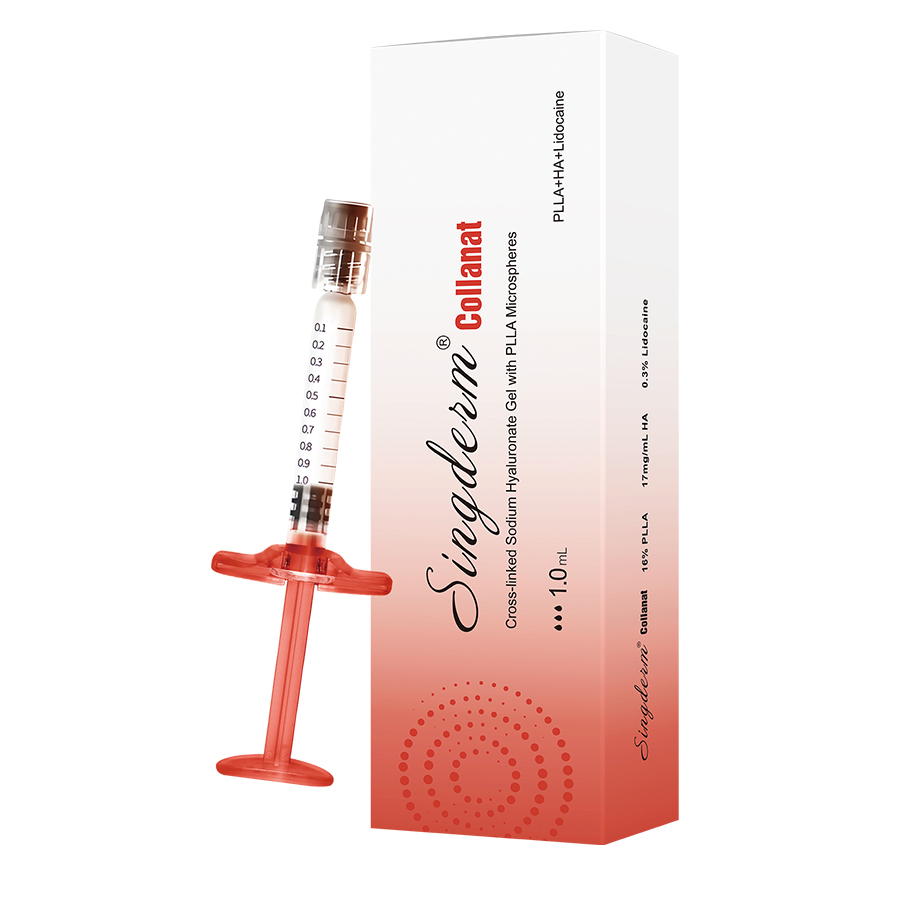
Rather than functioning as a conventional filler, Collanat follows a Dual-Action Regenerative Concept:
Immediately after injection, the cross-linked HA gel restores volume, smooths facial depressions, and enhances contour definition.
Patients benefit from:
Immediate lifting effect
Natural facial shaping
Enhanced hydration
Smooth integration into surrounding tissues
This instant improvement addresses one of the biggest challenges associated with traditional collagen stimulators, which often require patience before visible changes appear.
Following implantation, uniformly distributed PLLA microspheres gradually stimulate fibroblast activity.
As collagen remodeling progresses over the following months, the treated area develops stronger structural support, leading to:
Increased skin firmness
Improved elasticity
Enhanced dermal density
Long-lasting facial rejuvenation
Naturally maintained volume
Instead of relying solely on the injected material, Collanat encourages the body to regenerate its own collagen network.
This regenerative mechanism supports results that continue to improve long after the initial treatment.
One of the key innovations behind Singderm® Collanat lies in its optimized PLLA microsphere design.
According to the product specifications, the microspheres are engineered with a uniform spherical morphology and controlled particle size, promoting even dispersion throughout the injected tissue while helping minimize particle aggregation. This design supports a more predictable collagen-stimulation process and contributes to smoother aesthetic outcomes.
Compared with irregular particles, optimized spherical microspheres may provide several practical advantages:
More uniform collagen remodeling
Improved product distribution
Enhanced injection smoothness
Better tissue integration
Greater treatment consistency
For physicians, this translates into improved handling characteristics during injection. For patients, it contributes to natural-looking results and a gradual, harmonious improvement in facial appearance.
The greatest strength of a hybrid dermal filler is not simply the presence of two materials—it is the synergy between them.
The HA gel provides an immediate scaffold that restores lost volume and supports facial contours, while PLLA initiates a biological remodeling process beneath the surface. As the HA gradually metabolizes, newly synthesized collagen progressively replaces its structural role, helping maintain tissue support over time.
This complementary mechanism offers several important clinical advantages:
Immediate aesthetic improvement after treatment
Continuous collagen production during the healing process
Smoother transition between early and long-term results
Reduced appearance of abrupt volume loss
More natural and dynamic facial rejuvenation
For practitioners, this means greater confidence in achieving balanced outcomes. For patients, it delivers a treatment experience where visible improvements begin immediately and continue to evolve over the following months.
| Feature | Traditional HA Fillers | Traditional PLLA Fillers | Hybrid HA + PLLA Fillers (Singderm® Collanat) |
|---|---|---|---|
| Immediate volume restoration | Excellent | Minimal | Excellent |
| Instant visible results | Yes | Delayed | Yes |
| Collagen stimulation | Limited | Strong | Strong |
| Skin hydration | Excellent | No | Excellent |
| Progressive skin rejuvenation | Limited | Yes | Yes |
| Long-term structural support | Moderate | Excellent | Excellent |
| Natural-looking improvement over time | Moderate | Excellent | Excellent |
| Comprehensive anti-aging approach | Volume replacement only | Regeneration only | Volume restoration + Regeneration |
Hybrid fillers are particularly suitable for patients seeking comprehensive and long-lasting facial rejuvenation rather than temporary wrinkle correction.
Ideal candidates include:
They require both volume restoration and collagen regeneration.
Instead of dramatic volumization, many patients prefer gradual improvements that preserve natural facial expressions.
Hybrid fillers reduce reliance on frequent maintenance treatments by combining immediate correction with progressive tissue remodeling.
Individuals showing decreased skin elasticity or reduced dermal support can particularly benefit from PLLA-induced collagen synthesis.
Many long-term HA filler users are now seeking treatments that not only restore volume but also improve overall skin quality and structural integrity.
Hybrid fillers provide a logical next step.
The future of facial rejuvenation is no longer defined by instant volume replacement alone. Modern aesthetic medicine is embracing treatments that restore facial structure while activating the body's own regenerative potential.
By combining cross-linked hyaluronic acid with PLLA collagen stimulation, hybrid dermal fillers deliver what patients and practitioners have long sought: immediate visible improvement, progressive skin regeneration, and natural-looking, long-lasting outcomes.
Among this new generation of injectable products, Singderm® Collanat represents a significant advancement in regenerative aesthetics. Its dual-action technology bridges the gap between traditional HA fillers and standalone collagen biostimulators, offering clinics a versatile solution for comprehensive facial rejuvenation and providing distributors with an innovative product to meet the evolving demands of the global medical aesthetics market.
As the industry continues to shift toward biologically driven anti-aging therapies, hybrid fillers are poised to become a cornerstone of next-generation aesthetic practice.
 Call us on:
  Email Us:
  No. 125(E), 10th Street, Hangzhou Qiantang Area, Zhejiang, China
_Fillers.webp "Top Benefits of Poly-L-Lactic Acid (PLLA) Fillers for Regenerative Aesthetic Treatments")